
A brief history of the paper cutter
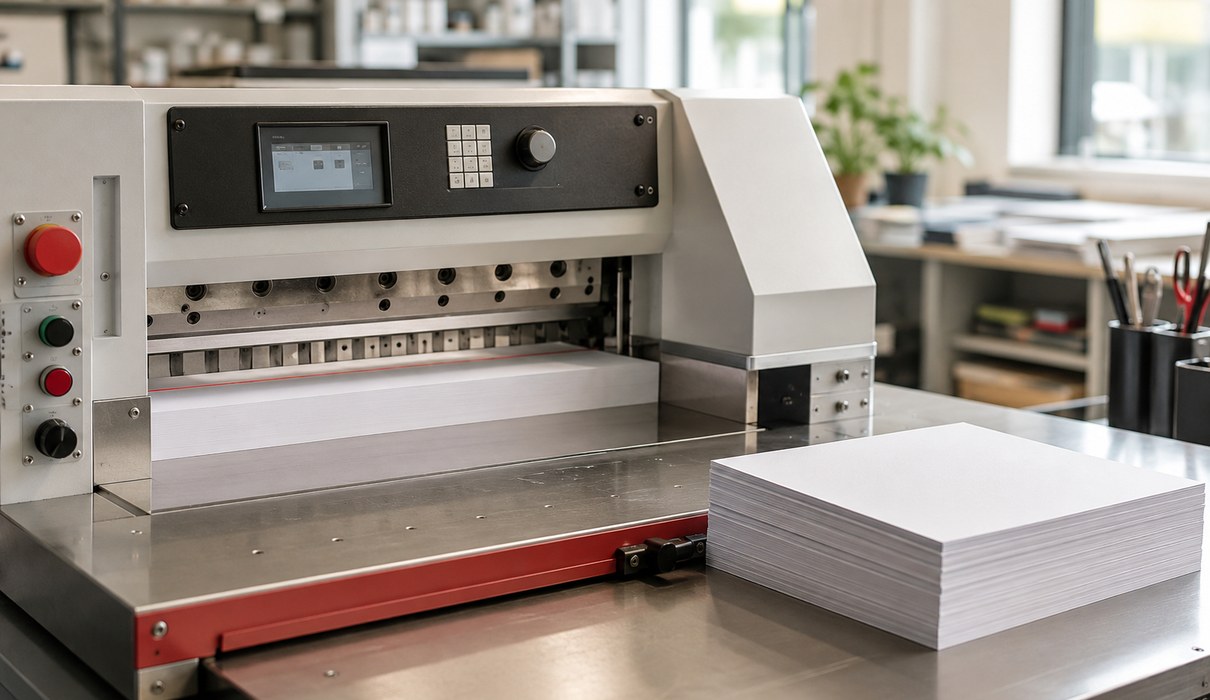
As the name suggests, a paper cutter is designed to slice a sheet or a stack of paper in a clean, straight line so that every piece comes out even in size and shape. Early designs relied on a fixed blade — one notable example was developed by Thirault in the 1830s — and the tool has evolved considerably since then, becoming safer, more precise, and far easier to use. Over the years, important improvements came from inventors and manufacturers in several countries: Fomm and Krause contributed advances in Germany, Furnival refined the design in England, and the work of Oswego and Seybold became prominent in the United States. From those origins, the humble paper cutter has grown into a family of tools ranging from simple desktop trimmers to powerful industrial machines.
The benefits of using a paper cutter
Both individuals and businesses use paper cutters because they make an otherwise fiddly task quick, clean, and accurate. Cutting paper by hand with scissors or a knife rarely produces straight, consistent edges, and it becomes impractical the moment more than a few sheets are involved. A paper cutter solves this neatly, producing professional results with little effort.
For a small task — trimming a few sheets at home or in a small office — a compact manual cutter is perfectly adequate. But when a large organisation needs to cut high stacks of paper regularly, manual methods simply cannot keep up. This is where electric and hydraulic paper-cutting machines come into their own, slicing through thick stacks easily and consistently. By doing so, they save significant time, effort, and cost, freeing up staff and resources for more productive work. Whatever the scale, the core purpose remains the same: to cut paper cleanly and precisely to the desired size and shape.
What an electric paper cutter can do
Electric paper cutters are remarkably versatile, and their usefulness extends well beyond ordinary office paper. Because they cut cleanly and accurately, they are ideal for preparing materials for all kinds of projects. They can trim not only paper but also card and chart paper, making them valuable for creating posters, three-dimensional crafts, greeting cards, and scrapbooks. The clean, straight edges they produce give finished work a professional, polished appearance that hand-cutting struggles to match.
Their appeal is not limited to large organisations. Students working on projects or artwork benefit just as much, since an electric cutter lets them prepare neat, precisely sized pieces quickly and easily. The speed and accuracy of these machines make them a genuine time-saver for anyone who regularly works with paper or card. Within the category, there are different brands and models offering a variety of cutting styles, capacities, and sizes, so it is possible to find a machine suited to almost any need — from light craft use to heavy commercial printing.
Important safety considerations
For all their advantages, electric paper cutters carry real risks, and they must be treated with respect. The same sharp, powerful blade that cuts paper so cleanly can cause serious injury if used carelessly. Anyone operating one should understand the correct technique and follow the manufacturer's safety guidance closely. Keeping hands well clear of the blade, never bypassing safety guards, and ensuring the machine is properly maintained are all essential habits.
Modern machines have been designed with operator safety firmly in mind. Many now include features such as dual push-button controls, which require both hands to be safely away from the cutting area in order to activate the blade. This simple but effective design makes it far harder for an accident to occur, ensuring that paper is cut safely as well as accurately. Blade guards, safety locks, and clear instructions further reduce the risk. When these features are used as intended, an electric paper cutter is a safe and highly efficient tool.
The practical takeaway
The electric paper cutter is a clear example of how a simple idea, refined over nearly two centuries, has become an indispensable tool. It turns a slow, imprecise chore into a fast, clean, and reliable process, serving everyone from students and crafters to large commercial printers. By choosing a model suited to your needs and observing sensible safety practices, you gain a tool that saves time, improves the quality of your work, and pays for itself many times over in efficiency. For any home, office, or business that regularly works with paper, it is an investment well worth making.
An electric paper cutter is just one example of how the right finishing equipment can transform productivity in any print or office environment. Asia Plus Office Automation, a leading post-press equipment provider in Malaysia and home to the ROYALTECH brand, supplies paper cutters, binding and laminating machines, and a wide range of print-finishing solutions backed by strong after-sales support. To enhance your workflow and output quality, explore the Office Automation range from Asia Plus.