
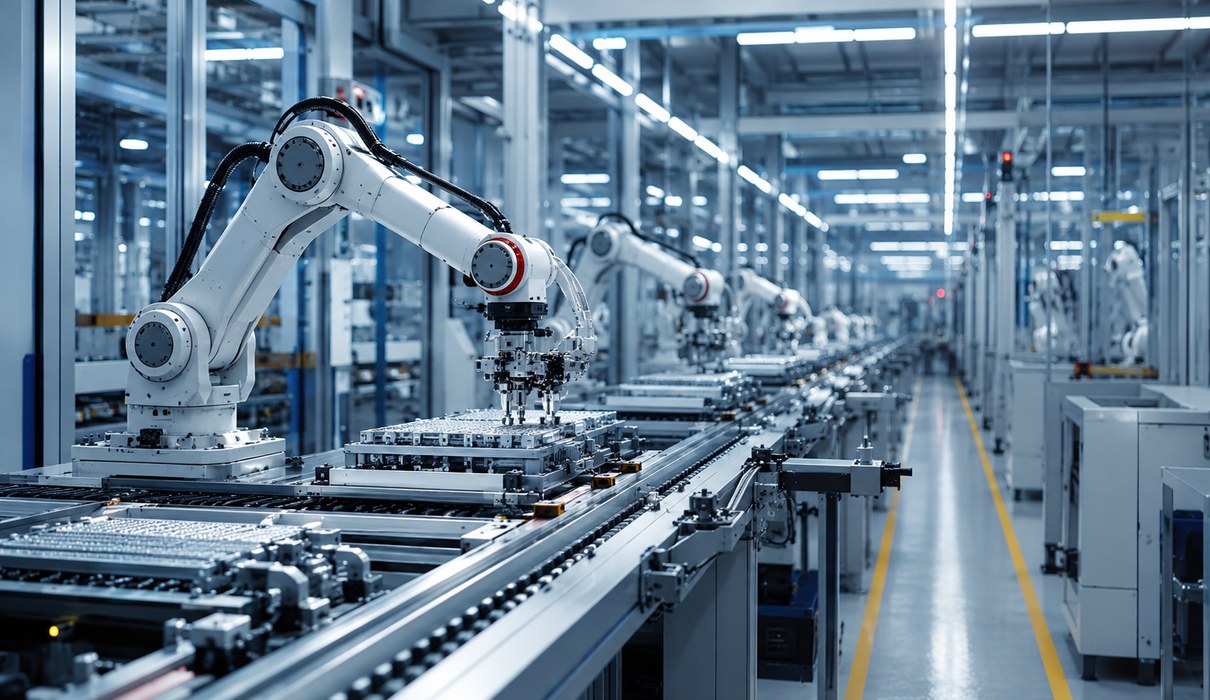
Industrial automation has become one of the defining features of modern manufacturing, and for good reason. At its simplest, industrial automation means using machinery, control systems, and technology to perform tasks that would otherwise be done manually. Automation devices are important because they speed up the process of production and allow a company to meet customer demand reliably, without the shortages and delays that can arise when everything depends on manual labour. In a competitive economy, that reliability and speed can be decisive.
Where automation is used
Automation is most widely used in the manufacturing sector, where repetitive, precise, and high-volume tasks are common. On a modern production line, automated systems can assemble components, package products, monitor quality, and move materials, often far faster and more consistently than human workers could manage. This does not necessarily replace people so much as redirect their effort toward tasks that require judgement, creativity, and oversight, while the machines handle the repetitive work.
By enabling a company to complete its production tasks on time, automation helps ensure that customers receive what they need when they need it. Few things damage a business's reputation faster than being unable to fulfil orders, and automation is one of the most effective ways to keep supply steady and dependable.
The link to economies of scale
One of the most significant benefits of industrial automation is its connection to economies of scale. When a company has sufficient automated capacity to complete its work efficiently, it can produce goods in larger volumes without a proportional increase in cost. As output rises, the total cost per unit tends to fall, because the fixed costs of equipment and facilities are spread across more units, and because automated processes use labour and materials more efficiently.
This falling cost per unit is the essence of economies of scale, and it is a powerful competitive advantage. A company that can produce more cheaply than its rivals has the freedom either to enjoy higher margins or to lower its prices and win more customers — or some combination of the two. Automation, by making large-scale efficient production possible, is often what unlocks these economies in the first place.
Benefits that reach the customer
Importantly, the advantages of industrial automation do not stop at the factory gate. When the cost of producing a good falls, that saving is frequently passed on to customers in the form of lower prices. This is a genuine benefit to consumers, and it has wider effects too. As prices fall, people's purchasing power effectively rises: the same amount of money buys more than it did before. Customers can afford a greater quantity of goods, or higher-quality versions, and enjoy a better standard of living as a result.
In this way, industrial automation creates a chain of benefits. The manufacturer gains efficiency, reliability, and lower costs; the business becomes more competitive; and customers benefit from lower prices and greater access to the goods they want. What begins as a change on the production line ends up improving outcomes for the whole market.
A foundation for growth and innovation
Beyond cost and speed, automation also supports quality and innovation. Automated systems can maintain consistent standards, reduce errors, and gather data that helps a company understand and improve its processes. This consistency is valuable in itself, since customers come to rely on products that meet the same standard every time. The data automation generates can also reveal opportunities to refine production further, creating a cycle of continual improvement.
Automation can also free a company to innovate. When routine production runs smoothly and efficiently, management and skilled staff have more capacity to focus on developing new products, improving designs, and responding to changing customer needs. In this sense, automation is not merely about doing the same things faster; it can be a platform for doing new and better things.
The bigger picture
Understanding the meaning of industrial automation means recognising it as far more than just machines on a factory floor. It is a strategic capability that helps companies produce efficiently, meet demand reliably, achieve economies of scale, and pass benefits on to customers through lower prices and better products. For the wider economy, the cumulative effect of many businesses adopting automation is greater productivity, more competitive industries, and improved purchasing power for consumers.
As technology continues to advance, industrial automation is likely to play an even larger role, becoming smarter, more flexible, and more widely accessible. For manufacturers, embracing it thoughtfully is increasingly not just an advantage but a necessity for staying competitive in a demanding global market.
Understanding automation is only the beginning – staying ahead means keeping up with the guides, reviews, and developments shaping Malaysian industry. Industrial.com.my is the country’s comprehensive industrial knowledge base, covering manufacturing, engineering, construction, energy, AI, and more through practical buyer’s guides and timely coverage. To stay informed on the trends driving the sector, follow the latest Industrial News at Industrial.com.my.